How Smart Card Machines Help You Understand Your Customers
Every card payment leaves a record, and a card machine with an app behind it turns those records into reports: which hours are busiest, what the average sale is, how many of this week's customers were here last week. This page describes what that reporting contains, using Dojo's Intelligence and Sidekick products as Dojo publishes them on 9 September 2026, and where a terminal's own end-of-day report stops.

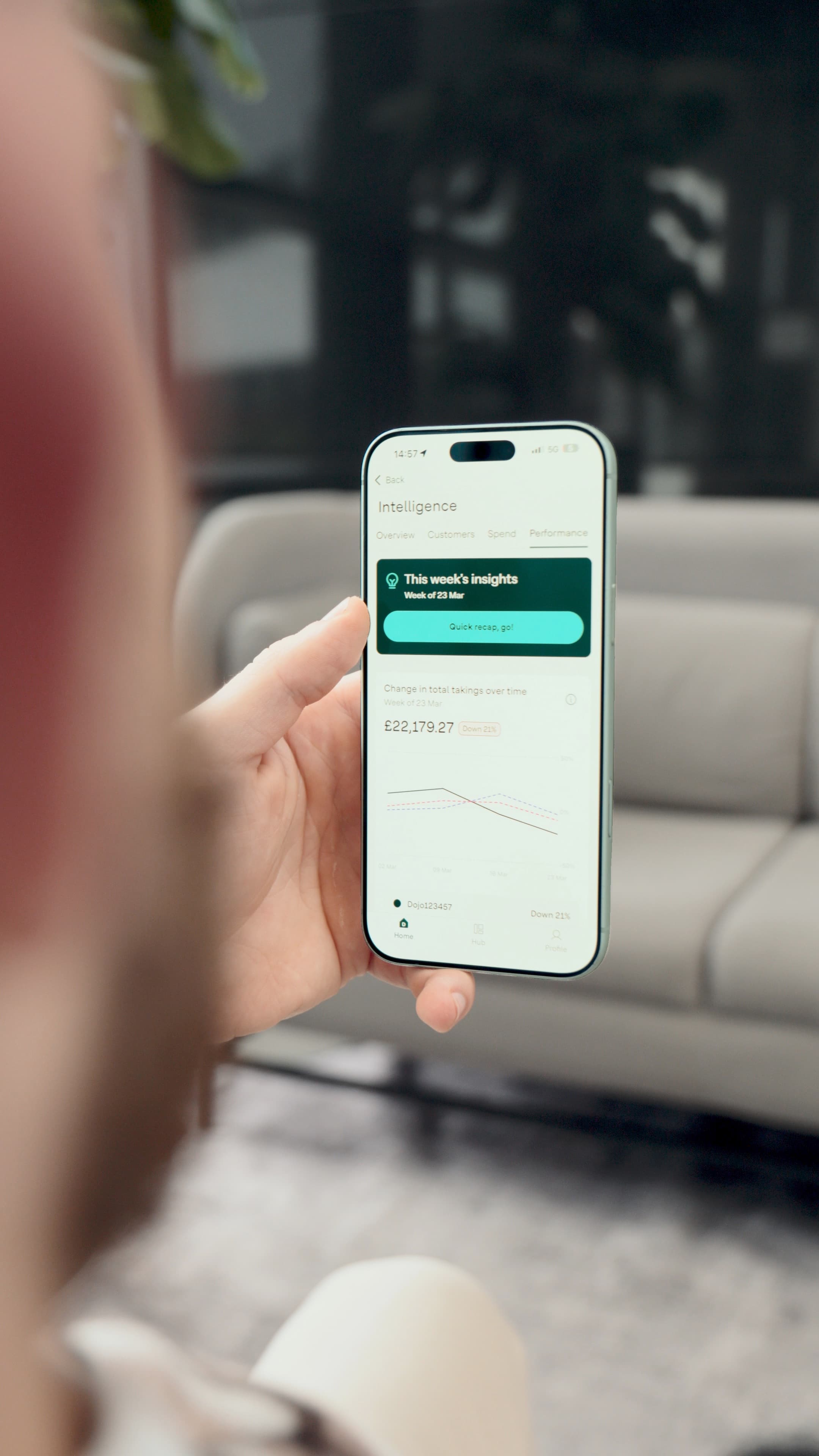
In brief
- Dojo Intelligence draws on what Dojo calls "the UK's richest dataset of 49 million cardholders" (dojo.tech, 9 September 2026)
- Competitor benchmarking compares your performance with similar businesses locally and nationally
- New versus returning customer spend is reported in aggregate, and the terms bar identifying any person
- Weekly performance reports arrive through the Dojo app on the Plus plan, £25 a month per location or £11.99 on the offer running from 24 August 2026
- Dojo Sidekick gives a business with more than one site real-time site performance across its locations, on every package
More Than a Payment Device
A terminal on its own takes payments and prints an end-of-day total. A terminal tied to an app keeps every transaction, sorts it by hour, day and device, and, on the platforms that pool data across their customers, sets your figures beside other businesses like yours. Dojo's pricing page says its platform is "trusted by 100,000+ businesses around the UK", and that pool is what the comparison features draw on.
The reports arrive on their own. Dojo's are weekly, through the app, so the reading takes minutes rather than an evening with a spreadsheet.
What the Transaction Data Can Show
Dojo's Intelligence terms describe the material as "aggregate data relating to how cardholders interact with you", so the picture is of the customer base rather than of any one customer. From that base the published reports cover:
How much new customers spend against returning ones, week by week
How you compare with similar businesses in your area and nationally
Footfall patterns across the week
Whether a promotion moved the numbers it was meant to move
Which days and hours carry the most transactions
The owner of a three-shop coffee group in Dojo's own case study of 24 January 2024 describes the use in one line: the app lets him know what is happening on each site when he is not in the cafe, across Ladbroke Grove, Balham and Croydon, with 95% of sales taken on card.
New vs Returning Customer Tracking
The split between new and returning customers is the one figure a till cannot produce, because a till sees a sale and not the person behind it. A business needs both groups, new customers for growth and returning ones for a floor under the takings, and the split says which of the two is moving.
Dojo's pricing page lists "track new/returning customer spend" as the first Plus feature, and its Intelligence page frames the question as "how many new customers am I attracting?". A rise in new customers in the week after a campaign is the campaign measured; a fall in returning customers over a quarter is a reason to look at the offer before the takings follow.
Peak Trading Times
Busiest hours and days decide the rota, the ordering and the timing of any offer. A card machine app maps transaction volume by hour and by day of the week, so the peaks and the dips are on the screen rather than in the manager's memory.
Practical example
Suppose a café's reports show Tuesday afternoons between 2pm and 4pm taking 40% less than the other weekday afternoons. A Tuesday-only offer that lifts that window by 25% is measurable within a month, because the same report that found the dip records whether it closed. The figures here are an illustration, not a client result.
See how your business compares with similar ones nearby
Dojo Intelligence and competitor benchmarking sit in the Plus plan. Get your Dojo quote through CapExpand.
Get your quoteAverage Transaction Values
Average transaction value is takings divided by transactions, and a card machine app has both numbers for every day it has been switched on. A rising average after a menu change says the change is being bought; a flat average after a 5% price rise says customers are buying fewer items per visit, which is a different problem from the one the price rise was meant to solve.
Competitor Benchmarking
A platform that processes payments for many businesses can pool the anonymised totals and set yours against similar businesses in your area or sector. Dojo's Intelligence page puts it as "benchmark your business performance against competitors locally and nationally" and promises to show "exactly how you perform against similar businesses in your area and beyond". Dojo does not publish how many businesses sit in any one local comparison set.
The same comparison shows the direction of the sector, so a quiet month reads differently when every similar business had one too.
Weekly Reports That Actually Help
A report only works if it gets read. Dojo lists "weekly performance reports" among the four Plus features on its pricing page, and its Intelligence page says the reports show trends "at a glance", covering:
Total revenue and transaction count versus the previous week
New versus returning customer split
Busiest and quietest trading periods
Average transaction value trends
How you compare with similar local businesses
The Decisions the Data Can Inform
The value of the reporting is in the decisions it changes, and each of these is one the transaction data speaks to:
Staffing the peak hours and cutting a shift in the quiet ones
Timing a promotion for the slowest trading window
Setting prices on what customers actually bought rather than on a guess
Measuring a marketing campaign by the new customers it brought in
Checking one site against another before checking either against the street
Dojo Intelligence as Dojo describes it
Most card machine providers give you a transaction report. Dojo Intelligence, on its product page on 9 September 2026, is "the smart tool that gives you access to the UK's richest dataset of 49 million cardholders", with three headings under it: understand your customers, understand your competitors, understand your business. The page names weekly reports, spending habits, footfall patterns and a comparison with the market, and asks the three questions the product is built round: how am I performing against competitors, how successful was my last promotion, and how many new customers am I attracting.
So a cafe in Shoreditch can see whether its Wednesday lunch trade sits above or below similar businesses nearby, and a salon in Birmingham can see whether its regulars are coming in less often, both from the weekly report on the phone rather than from a login and a search.
Dojo Sidekick for more than one location
Dojo's Sidekick page, read the same day, answers the multi-site question directly: it is "designed to support businesses with multiple locations", showing real-time site performance and managing staff access and user permissions across those locations from one platform, with location-based controls for a new site. Its reporting section lists real-time transactions, transfer statuses and history, takings reports and CSV files, and the pricing page marks Sidekick as included with every package.
Single-site versus multi-site reporting
The two questions are different, and Dojo answers them with two products. A single site wants to know whether last week was good, so the comparison it needs is the market: Dojo Intelligence benchmarks one business against similar businesses locally and nationally and splits its takings between new and returning customers. On the pricing page that sits in the Plus plan at £25 per month per location, £11.99 for new customers and new locations of existing customers from 24 August 2026, with the Essential plan free and listing real-time transactions, card acceptance and PCI compliance as its key features.
A group of three or six sites wants to compare its own locations with each other before it compares any of them with the street. That view lives in Dojo Sidekick, which Dojo's page describes as real-time site performance across multiple locations, staff access and user permissions managed from one platform, and location-based controls for a new site. The plan price is per location, so three sites on Plus are three subscriptions, £75 a month at the list price or £35.97 on the new-customer offer, and Dojo's pages do not say whether the benchmark is reported site by site or for the account as a whole.
The figure that changes between the two is the sample. One café in a market town is benchmarked against whatever similar businesses Dojo holds nearby, and Dojo publishes no count by postcode, so a single week at one site is noise and a quarter is direction. Six sites pooled give the same owner a comparison the platform cannot skew: their own locations, on the same tariff, over the same weeks.
Dojo Intelligence versus basic sales reporting on a terminal
Every terminal reports. The difference is what the report is compared with, and the table sets Dojo's published features on 9 September 2026 against what a terminal's own end-of-day report contains.
| Feature | Terminal sales report | Dojo Essential (free) | Dojo Plus with Intelligence (£25/month/location) |
|---|---|---|---|
| Takings by day and device | Yes | Yes, real-time transactions in the app | Yes |
| Transfer status and history | No | Yes, via Sidekick | Yes |
| CSV export of transactions | Sometimes, by provider | Yes, via Sidekick | Yes |
| New versus returning customer spend | No | No | Yes |
| Benchmark against similar local and national businesses | No | No | Yes |
| Weekly performance report | No | No | Yes |
| Refunds | On the terminal | On the card machine only | Remotely via Sidekick |
| Cardholder dataset behind the comparison | Your own transactions | Your own transactions | 49 million cardholders a month, per Dojo |
Dojo columns from dojo.tech/pricing ("Compare plan features"), the Dojo Intelligence page and the Sidekick page, read 9 September 2026. The terminal column describes a generic end-of-day report and is not a claim about any named provider.
One limit is in the terms rather than the marketing. The Dojo Intelligence terms (version 1.0, published 20 April 2026) define the service as "the cardholder behaviours which we provide to you through the Dojo app", provide it under a subscription plan, and supply it on an "as-is" or "as-available" basis with no responsibility for errors. The same terms bar using it to identify any data subject, including by combining it with another data set. Read the weekly report as a trend, and check any figure you would act on against the terminal's own takings first.
Dojo case study, published 24 January 2024
Neev + May: three London coffee shops on Dojo Go
Owner Sunni Parekh moved the group's three sites from RMS to Dojo, and Dojo's write-up gives three figures: around £100 a month previously lost to missed and mis-keyed transactions, "potentially 25% more" turnover at the busiest times, and around £1,000 a month more across the three shops. On the reporting he says: "It's made a huge difference to our operations across all three sites." Dojo's figures, not ours.
Reporting questions
What does Dojo Intelligence give a single-site business that the terminal does not?▼
The comparison set. A terminal report is a list of your own transactions; Dojo Intelligence, as described on dojo.tech on 9 September 2026, benchmarks your performance against similar businesses locally and nationally, splits new from returning customer spend, and sends a weekly report, drawing on what Dojo calls a dataset of 49 million cardholders a month. It sits in the Plus plan at £25 per month per location, £11.99 for new customers and new locations of existing customers from 24 August 2026.
How does Dojo Intelligence differ for a multi-location business?▼
The plan price is per location, so three sites on Plus cost three subscriptions, £75 a month at list. The cross-site view comes from Dojo Sidekick rather than from Intelligence: Dojo's Sidekick page says it shows real-time site performance and manages staff access and user permissions across multiple locations from one central platform, and sets up new sites with location-based controls. Whether the benchmark can be read per site or only per account is not stated on the public pages.
Is Dojo Intelligence better than basic sales reporting on a payment terminal?▼
It answers a different question. A terminal's own report tells you what you took, by day and by device. Dojo Intelligence adds how you compare with the market and whether the customers paying are new or returning, which a single business cannot calculate from its own data. For a site that only wants to reconcile the till, the free Essential plan's real-time transactions are the relevant feature, and the Sidekick app's takings reports and CSV files come with every package.
What are the published features of Dojo Intelligence?▼
On 9 September 2026 the pricing page lists four Plus features: track new/returning customer spend, competitor benchmarking, weekly performance reports and process refunds remotely. The Dojo Intelligence page adds local and national benchmarking, promotion measurement, footfall patterns and access to 49 million cardholders per month. The Dojo Intelligence terms (version 1.0, 20 April 2026) define it as "the cardholder behaviours which we provide to you through the Dojo app", supplied under a subscription plan and on an "as-is" basis.
Does Dojo Intelligence identify individual customers?▼
No. Its terms bar using it "for the purpose of identifying any data subject or other person", including by combining it with any other data set, and define cardholder behaviours as aggregate data on how cardholders interact with you. The reports describe counts of new and returning customers, spend and footfall patterns rather than named people.
Sources and references
Dojo pages, terms and fees schedule read on 9 September 2026.
- Dojo Intelligence page: 49 million cardholders, local and national benchmarking, weekly reports
- Dojo pricing page: Essential and Plus plans, the £11.99 offer, compare plan features, 99.99% uptime, 100,000+ UK businesses
- Dojo Sidekick page: multi-location reporting, permissions, CSV files
- Dojo terms and conditions version 2.0, 20 April 2026, including the Dojo Intelligence terms and Dojo Plans terms (PDF)
- Dojo fees schedule version 2.1, published 24 August 2026: minimum monthly payment and subscription break fee rows (PDF)
- Dojo case study, 24 January 2024: Neev + May coffee shop group
- Dojo Go Max page: 450 EPOS integrations, 110,000 businesses
Access your business data
A card machine that reports who your customers are, when they visit and how you compare with similar businesses nearby.
Get a free quoteWhat the reporting is actually worth
The basic reporting comes with the account, so the honest question is what it changes. A site taking £15,000 a month at 1.2% pays £180 a month in transaction fees, and shifting the rate by 0.2% saves £30 a month, or £360 a year. Working out from the dashboard that Tuesday evening is dead, and cutting one shift, saves more than that inside a fortnight.
The comparison set is other merchants on the same platform, not every business on your street. Dojo describes a dataset of 49 million cardholders and its pricing page says 100,000+ UK businesses are on it, which is plenty in a town centre and thin in a village. Nobody publishes the count by postcode, so read a single week as noise and a quarter as direction.
A dashboard is only as good as the terminal feeding it. Dojo's pricing page claims 99.99% uptime. On £15,000 a month, a day offline is roughly £500 of trade, which swamps anything the reporting is going to find for you that week.
One last check on what comes free and what does not. Sidekick's reporting is included with the account and Intelligence is a Plus feature at £25 a month per location. The fees schedule of 24 August 2026 also carries a minimum monthly payment, charged only in a month where your transaction fees fall below the agreed figure, and prices it "based on your agreed plan"; Dojo publishes no pounds amount for it. On a £15,000 month it is doing nothing. On a £2,000 month it could be most of the bill, and the figure to ask for is the one in your own application documents.
CapExpand Ltd (Company No. 14433858) is an authorised Dojo partner, not a card machine manufacturer. Card machine pricing and availability are subject to change. Our card machine services are not regulated by the Financial Conduct Authority and fall outside our appointment as an Appointed Representative of White Rose Finance Group Limited, which covers credit broking only.